Parliamentary reception celebrates unique mission of Pears Cumbria School of Medicine
The groundbreaking mission of the Pears Cumbria School of Medicine has been celebrated at an event for parliamentarians and policymakers in Westminster.
The Pears Cumbria School of Medicine (PCSM), the first graduate-entry medical school in Cumbria, opened in August 2025 with an initial cohort of 58 students, including 45% of students from a widening participation background.
The School is a unique partnership between Imperial College London and the University of Cumbria, with philanthropic support from the Pears Foundation.
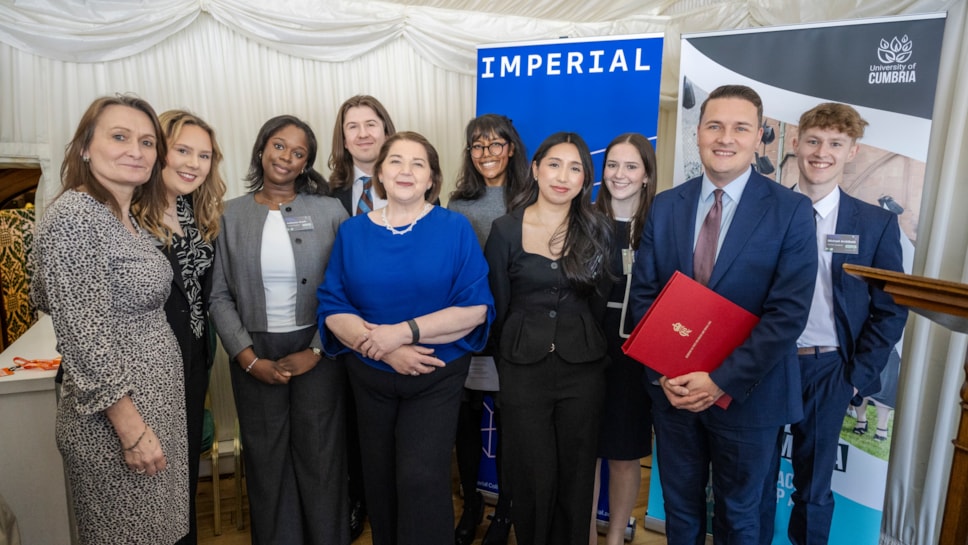
At a House of Commons event, senior leaders from Imperial and Cumbria shared with MPs how PCSM can act as a leading new model for medical education, supporting UK Government priorities on NHS workforce needs, primary care access and preventive healthcare.
It provided an opportunity for MPs and national health leads to learn more about how solutions grounded in the specific needs of healthcare in Cumbria can be replicated across the UK – to the benefit of patients and local communities.
Attendees also heard from the Rt Hon. Wes Streeting MP, Secretary of State for Health and Social Care, who spoke about the importance of improving access and widening participation for medical education, particularly in regions with persistent health inequalities.

The Rt Hon. Wes Streeting MP, Secretary of State for Health and Social Care, said: “The challenge that we are trying to confront is that, in terms of our potential as human beings, talent is everywhere, but opportunity is not.
“That’s why I’m proud of the fact that we’ve got this partnership between Imperial College London - whose excellence, particularly in science and medicine, is renowned the world over - with the University of Cumbria to make sure that we’re combining excellence and opportunity, and that we're recognising the untapped potential of people, not just across Cumbria, but right across the north of England.”
PCSM has been set up with a unique focus on tackling the chronic shortage of doctors in Cumbria, aiming to improve the recruitment, training and retention of doctors in a region which has faced longstanding critical health inequalities. More than half [57%] of the new school’s first year intake is from the North of England – with one in seven [14%] students from Cumbria itself.

Speaking at the event, Professor Hugh Brady, President of Imperial, said: “The Pears Cumbria School of Medicine is undoubtedly a testament to what is possible when ambition meets partnership - when universities, philanthropists, the NHS, Government, and communities come together with a shared purpose. When that happens, we can and are doing extraordinary things.”
The School has been developed with a bespoke curriculum that focuses on prevention and the delivery of high-quality care in sparsely populated and poorly connected rural and coastal settings. Students will undertake a community-based project and learn about using digital technology, such as large data models and AI in healthcare delivery.
Professor Julie Mennell DL, Vice Chancellor of the University of Cumbria, said: “The Pears Cumbria School of Medicine reflects the University of Cumbria’s deepest commitments: to place, to people, and to partnership. It is about growing our own talent, bringing new talent into Cumbria, and enabling local people and new students and residents to train as doctors. Not just strengthening our workforce but also providing value to our communities, for now and for decades to come.”
Julie Minns, MP for Carlisle, described the opportunities presented by PCSM as “incredibly exciting”.
She said: “The School’s vision of attracting and retaining homegrown talent in Carlisle and North Cumbria is transformatively important. Areas like ours have struggled for years with recruitment and retention across primary and secondary care, and I see that every single week through local residents who contact me about not being able to see a GP or not being able to get the treatment they need.”
Parliamentarians also heard from student representatives at PCSM, who highlighted how they came to study medicine and why they chose to study at the School.
The opening of PCSM was made possible by a £5m gift from the Pears Foundation – a charitable foundation with a long-term interest in philanthropic investments in education and health.
Sir Trevor Pears, Executive Chair at the Pears Foundation, said: "From the very first conversations, it was clear to us that instead of receiving a funding proposal we were being presented with an exciting opportunity to be part of something very special."
"The need and the challenges were clear, as was the vision – a focus on harnessing homegrown talent and a place-based partnership approach.
“The partnership between Imperial’s world-class medical expertise, along with their no-nonsense mission to be useful, married to the University of Cumbria’s strength and expertise in nursing, midwifery, paramedic science and applied medical sciences was very compelling.”
He added: “There are so many potential wins for this fabulous project – for the students, for both universities and for the county of Cumbria and its residents."

Training and retaining doctors in Cumbria
As part of its mission to improve health outcomes in Cumbria, PCSM aims to support local training of doctors and the retention of doctors in the region. However, at present, training posts in Cumbria are limited.
Working with regional NHS partners and training providers, the School aims to develop:
- Training pathways focused on Cumbria, with funding models that recognise the specific needs of sparsely populated and poorly connected rural settings.
- A high-quality research and education environment that harnesses new technologies to enable innovation and better evaluate changes in healthcare.
Doctors tend to settle close to where they complete their specialist training, which presents an issue for regions like Cumbria which are often less able to provide training pathways and less able to retain locally educated, highly skilled doctors.
PCSM has called for measures to improve training pathways to allow more doctors to continue their training within rural areas, not away from them.